










The crypto market currently feels like a coiled spring. While the “Fear & Greed Index” is pinned at a painful 10 (Extreme Fear) due to geopolitical shocks, Wall Street’s largest bank is looking past the red screens.
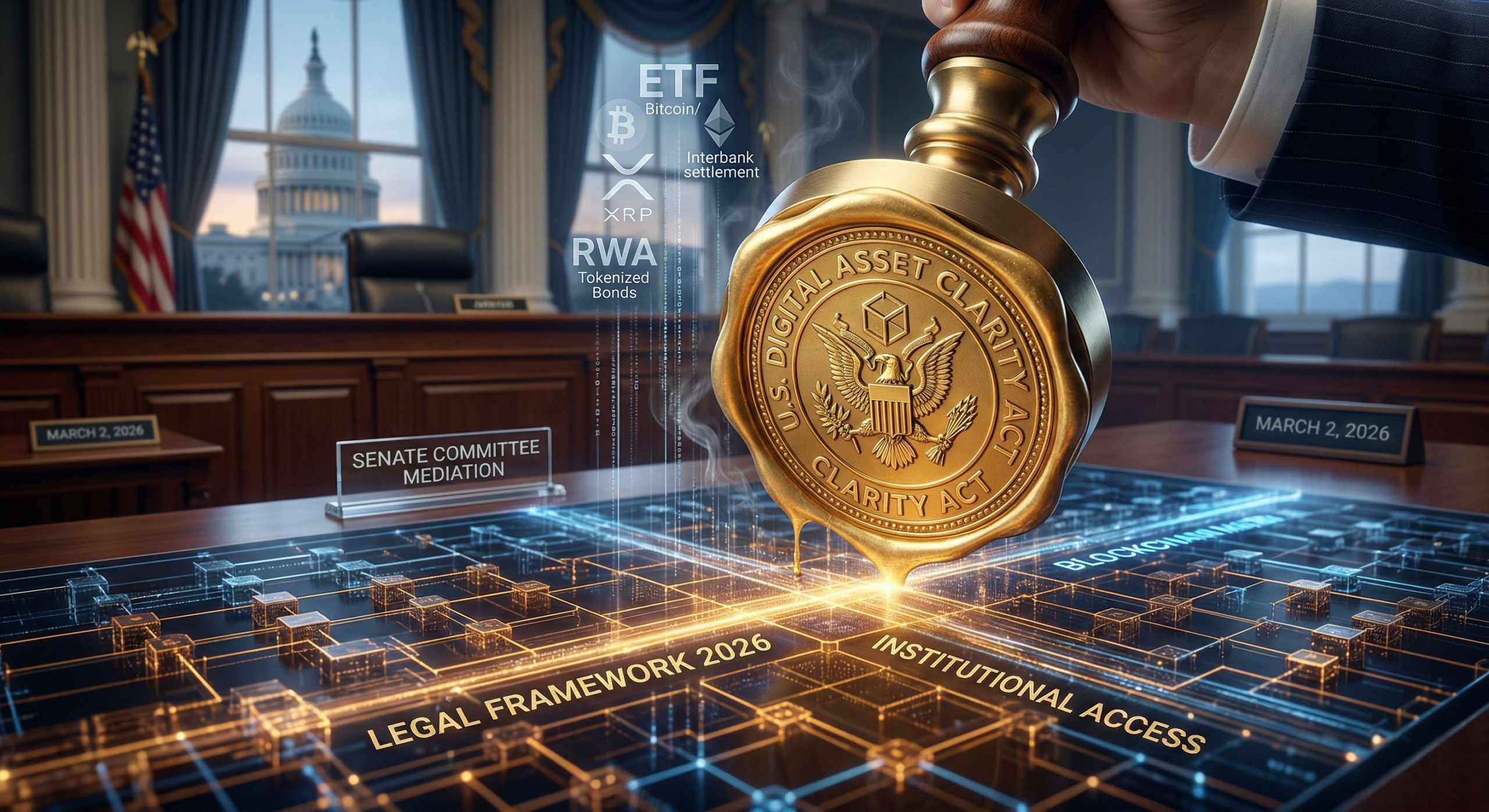
In a landmark research report released today, JPMorgan Chase analysts led by Nikolaos Panigirtzoglou have identified a singular “super-catalyst” for the second half of 2026: the Digital Asset Market Structure CLARITY Act.
At Auraski, we follow the “Smart Money” trail. Here is why the JPMorgan report suggests that the current volatility is merely the “final flush” before a massive structural shift.
1. The “Mid-Year” Deadline
The CLARITY Act has already cleared the House of Representatives with bipartisan support, but it currently faces a high-stakes standoff in the Senate.
- The Timeline: JPMorgan analysts predict a mid-year approval (June/July 2026).
- The Probability: Ripple CEO Brad Garlinghouse has been even more aggressive, placing an 80% to 90% probability on the bill passing as early as April 2026.
- The Catalyst: If passed, JPMorgan believes it will “open the floodgates” for trillions in institutional pension funds and corporate treasuries that are currently sidelined by legal ambiguity.
2. The Stablecoin “Yield Battle”
The primary reason the bill is currently stalled in the Senate is a fierce “lobbying war” over stablecoin rewards.
- The Crypto Side: Coinbase and other exchanges want the legal right to offer yield or rewards on stablecoins (like USDC), arguing it is essential for Web3 utility.
- The Banking Side: Traditional banks have lobbied aggressively against this, warning of a “deposit flight” where consumers move cash out of low-yield bank accounts and into high-yield stablecoins.
- The Mediation: The White House is currently mediating this dispute, with a compromise expected by the end of March.
3. Ending “Regulation by Enforcement”
Perhaps the most bullish aspect of the JPMorgan report is the prediction that the CLARITY Act will officially end the era of “Regulation by Enforcement” in the U.S..
The bill establishes a clear transition path for tokens:
- Security to Commodity: It defines a framework for how a token can move from a “security” classification to a “commodity” once the underlying network becomes sufficiently decentralized.
- Bank Custody: For the first time, traditional banks would have a clear federal green-light to directly custody digital assets for their clients.
- RWA Tokenization: The bill provides the legal “railroad tracks” needed for the Tokenization of Real-World Assets (RWA), such as bonds and real estate, to move on-chain at scale.
🦁 Auraski Intelligence Verdict
JPMorgan isn’t just predicting a price bounce; they are predicting a Regime Change. > The CLARITY Act is the missing piece of the puzzle for 2026. Without it, Bitcoin is a speculative asset; with it, Bitcoin (and XRP) become Institutional Infrastructure.
The Bottom Line: We are currently in the “Wait-and-See” mode. The March 1 White House deadline for a stablecoin compromise has passed, and we expect a “Leaked Draft” of the final bill to hit the news cycle any day now.
The Play: Accumulate the “Legal Leaders.” Projects with deep regulatory groundwork—like Ripple (XRP) and Coinbase (COIN)—are the primary beneficiaries of this catalyst. When the law clarifies, the capital follows.