









While the retail market obsesses over $2 or $5 price targets, a much more radical thesis is quietly gaining ground among institutional analysts. In a landscape where Bitcoin is struggling with a “rotation to AI,” financial pundits like Jake Claver (CEO of Digital Ascension Group) are arguing that XRP isn’t just a speculative token—it’s a global liquidity requirement.
The argument is simple but shocking: For XRP to function as the back-end settlement layer for the world’s banks, it doesn’t just want to be at $1,000—it has to be.
1. The “Mechanical Necessity” of a $1,000 Price Point
The core of the $1,000 thesis is not “hype,” but mathematical bandwidth.
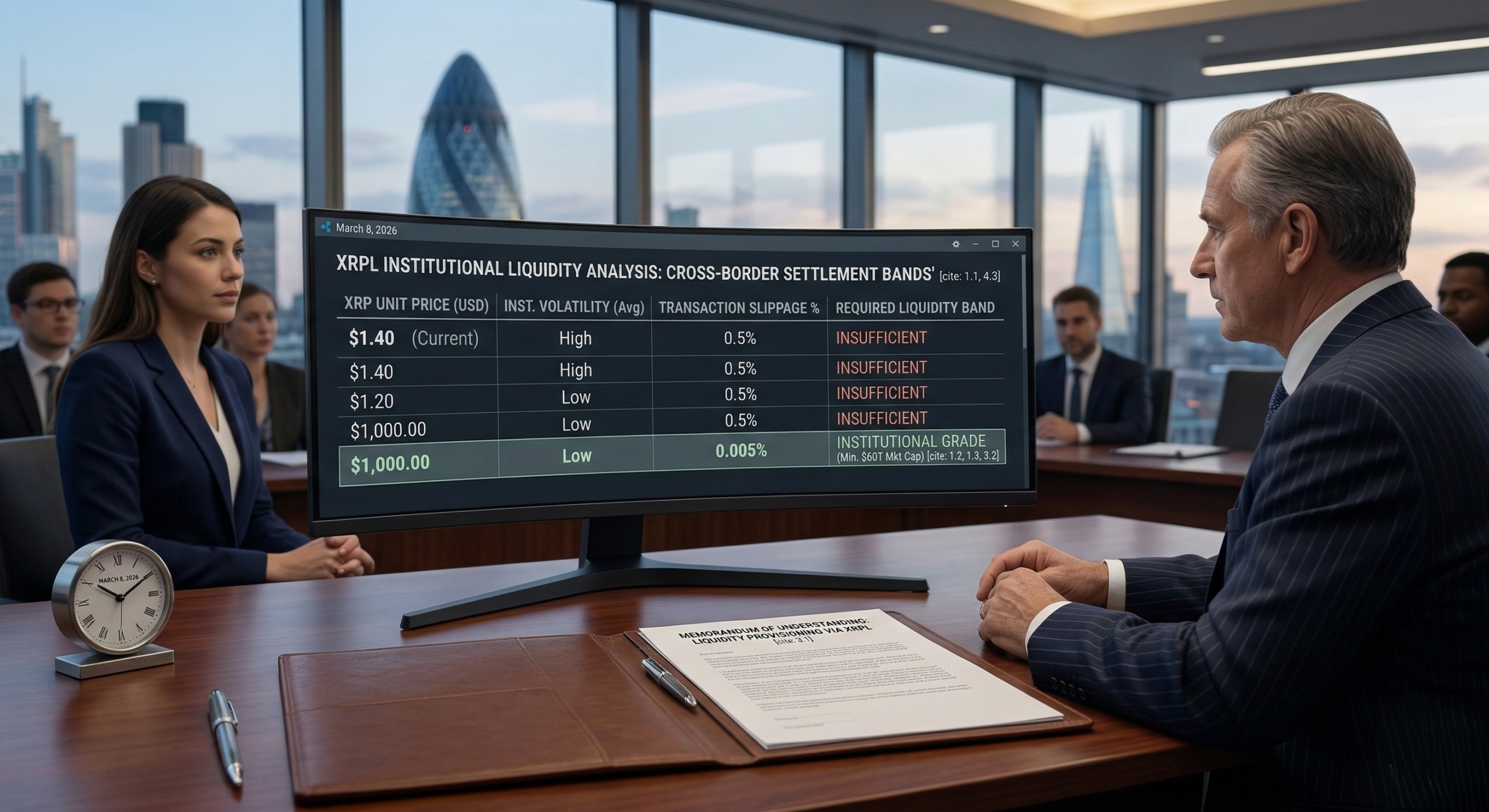
If XRP is to be used by institutions like BNY Mellon, Fidelity, and JPMorgan to settle global cross-border payments (a market moving over $1 trillion daily), the current market cap is physically too small to handle the volume without causing catastrophic price slippage.
- The Liquidity Floor: Claver argues that banks are not interested in a volatile, low-value asset. They require a “High Stable Value” to move billions in seconds.
- The Math: At $1.40, a $1 billion transfer would move the entire market. At $1,000, that same transfer becomes a “rounding error” in a multi-trillion dollar liquidity pool, providing the stability institutional compliance teams demand.
2. The “Domino Effect” of the CLARITY Act
Every institutional thesis for 2026 hinges on the CLARITY Act, which Ripple CEO Brad Garlinghouse believes has an 80–90% chance of passing by April.
- The Classification: The Act would officially codify XRP as a “Digital Commodity,” finally allowing Tier-1 banks to hold it on their balance sheets without legal risk.
- The Custody Wave: With statutory certainty, BNY Mellon—the world’s largest custodian—could move from “experimental” custody to full-scale operational integration of the XRP Ledger (XRPL).
3. Supply Shock: The 20% Escrow Rule
A hidden clause in the CLARITY Act draft could trigger the ultimate supply squeeze. The Act suggests that for a network to be classified as a “Mature Digital Commodity,” the lead developer cannot control more than 20% of the supply.
- The Ripple Dilemma: Ripple currently holds roughly 34% in escrow. To comply with the CLARITY Act, Ripple may be forced to burn, divest, or lock away a massive portion of its holdings, creating a historic “Supply Shock” just as institutional demand from Spot ETFs (which have already absorbed over $1.3B) begins to peak.
Realistic vs. Exponential: The 2026 Forecasts
| Target | Probability | Catalyst |
| $2.80 – $8.00 | High | Standard Chartered’s “Institutional Floor” & CLARITY Act passage. |
| $15 – $30 | Medium | Full Tier-1 bank ODL adoption & Ripple Fed Master Account. |
| $1,000 | Long-Term/Extreme | XRP becomes the primary liquidity layer for global RWA & SWIFT replacement. |
🦁 Auraski Intelligence Verdict
The “$1,000 XRP” is a utility-driven end-state, not a speculative moon-shot for 2026. However, the logic is sound: you cannot run a $100 trillion global economy on a $1 asset. >
The Bottom Line: We are in the “Building Phase.” The Kraken Fed Master Account and the Strike 50-state sweep are the plumbing. The CLARITY Act is the green light. Once the light turns green, the repricing of XRP will be a “Crisis Moment” event, not a gradual climb.
The Play: If you believe the institutional thesis, current levels are a gift. But remember: the road to $1,000 involves a $60 trillion market cap. This is a play for the next decade, not the next week.