









The promise of the 2024 AI summer has finally solidified into the dominant economic force of 2026. We have moved past Large Language Models that merely generate text to Large Action Models (LAMs)—intelligent Autonomous Agents that can execute decisions.
These are not chatbots. These are decentralized software entities that own their own wallets, manage their own capital, and engage in machine-to-machine commerce without human intervention. They are the new laborers of the Agentic Economy.
For investors in 2026, the strategy has shifted from “AI speculation” to “Infrastructure ownership.” The value is no longer in the AI model itself, but in the tokenized plumbing that allows these agents to trade, settle, and coordinate on the blockchain.
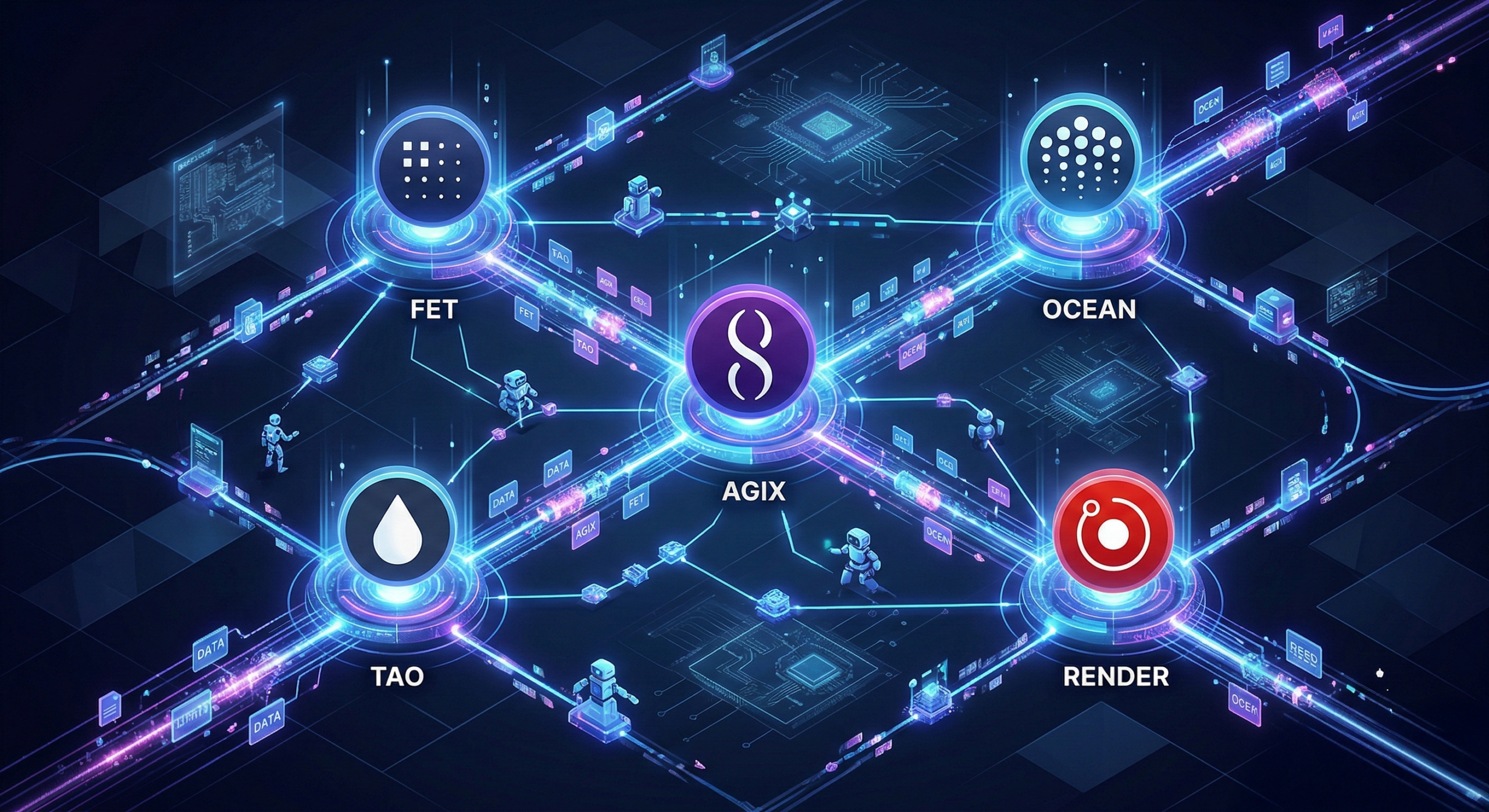
At Auraski, we have isolated the top 5 utility tokens that are constructing the financial backbone of this autonomous future.
1. Fetch.ai ($FET): The Action Layer of the ASI Alliance
Fetch.ai is the pioneer of Autonomous Economic Agents (AEAs). Within the Artificial Superintelligence (ASI) Alliance, Fetch provides the core infrastructure for specialized agents to live, negotiate, and perform complex tasks autonomously—from supply chain optimization to booking travel.+1
- Why it’s Critical in 2026: FET is the digital “fuel” of the agentic world. Agents must use FET to register on the network, access collective intelligence, and execute economic transactions. It is the definitive “Medium of Exchange” for autonomous machine labor.+1
2. Bittensor ($TAO): The Settler of Decentralized Intelligence
Bittensor is creating an open marketplace for machine intelligence itself, scored by performance rather than centralized authority. Organized into specialized subnets—spanning tasks from text generation to fraud detection—independent developers deploy AI services that compete to earn TAO tokens.+1
- Why it’s Critical in 2026: $TAO is transitioning into the settlement layer for machine intelligence workloads. As specialized subnets begin settling massive inference and compute workloads, TAO becomes the required transactional currency to access this global, decentralized “commodity market for intelligence”. Its hard cap of 21 million tokens makes it the scarcity play of the AI sector.+1
3. SingularityNET ($AGIX): The Cognitive Marketplace
SingularityNET, led by Dr. Ben Goertzel, focuses on creating a decentralized marketplace where AI algorithms can be discovered, monetized, and combined. In 2026, it serves as the primary “cognitive store” where Fetch’s action-oriented agents buy the specialized algorithms they need to solve complex problems.
- Why it’s Critical in 2026: $AGIX facilitates the integration of diverse cognitive functions. It allows specialized AIs—such as a medical diagnostic model or a sophisticated legal analyzer—to expose their APIs to the Agentic Economy. It is the mandatory payment system for accessing tokenized AI expertise.
4. Ocean Protocol ($OCEAN): The Fuel for Data-Hungry Models
AI agents can “reason,” but they cannot act programmatically without data and capital infrastructure. Ocean Protocol provides the secure, privacy-preserving data layer, allowing sensitive or proprietary datasets to be tokenized and shared via Data NFTs and Compute-to-Data technology.
- Why it’s Critical in 2026: In the Agentic Economy, data is the raw commodity. Agents use $OCEAN to purchase access to high-quality datasets to train, adapt, and make optimized decisions without violating privacy regulations like GDPR. OCEAN is the key to unlocking the multi-trillion dollar “Tokenized Data Economy”.+1
5. Render Network ($RENDER): The Compute Backbone
Agents required massive compute power to perform their tasks—from training lightweight models to executing complex 3D rendering jobs. Render Network bridges the gap by connecting users needing high-performance GPUs with node operators offering idle resources. Its migration to Solana has successfully streamlined its incentive structure for thousands of micro-transactions.+1
- Why it’s Critical in 2026: $RENDER is the foundation of the Decentralized Physical Infrastructure (DePIN) narrative. With monthly throughput approaching millions of rendered frames, it provides the essential hardware firepower that allows AI agents to operate on a global scale, circumventing the bottlenecks and massive overheads of centralized cloud providers.
🦁 Auraski Intelligence Verdict
The shift from text generation to autonomous action is the definitive market catalyst of 2026.
The Strategy: While pure-play AI models fight a war of recentralization, the projects listed above share a common trait: Infrastructure Ownership.
The winners of the Agentic Economy are not those who build the smartest AI, but those who own the bottlenecks of the decentralized AI ecosystem—the data (OCEAN), the compute (RENDER), the expertise (AGIX), the intelligence (TAO), and the action infrastructure (FET).