







For months, the global economy has been held hostage by the threat of a “Maximum Escalation” between the United States and Iran. Analysts predicted that a closure of the Strait of Hormuz would send oil to $150 and Bitcoin into a “Deleverage Abyss.” But as of March 10, 2026, the narrative has taken a sharp, unexpected turn.
The “War Scare” is fading, but not because of a peace treaty. It’s fading because of a more fundamental, existential crisis: Water.
At Auraski, we track the “Resource Realignment” that traditional analysts miss. Here is why the “Iran Pivot” just saved the Bitcoin rally.
1. Water Scarcity: The Silent De-escalator
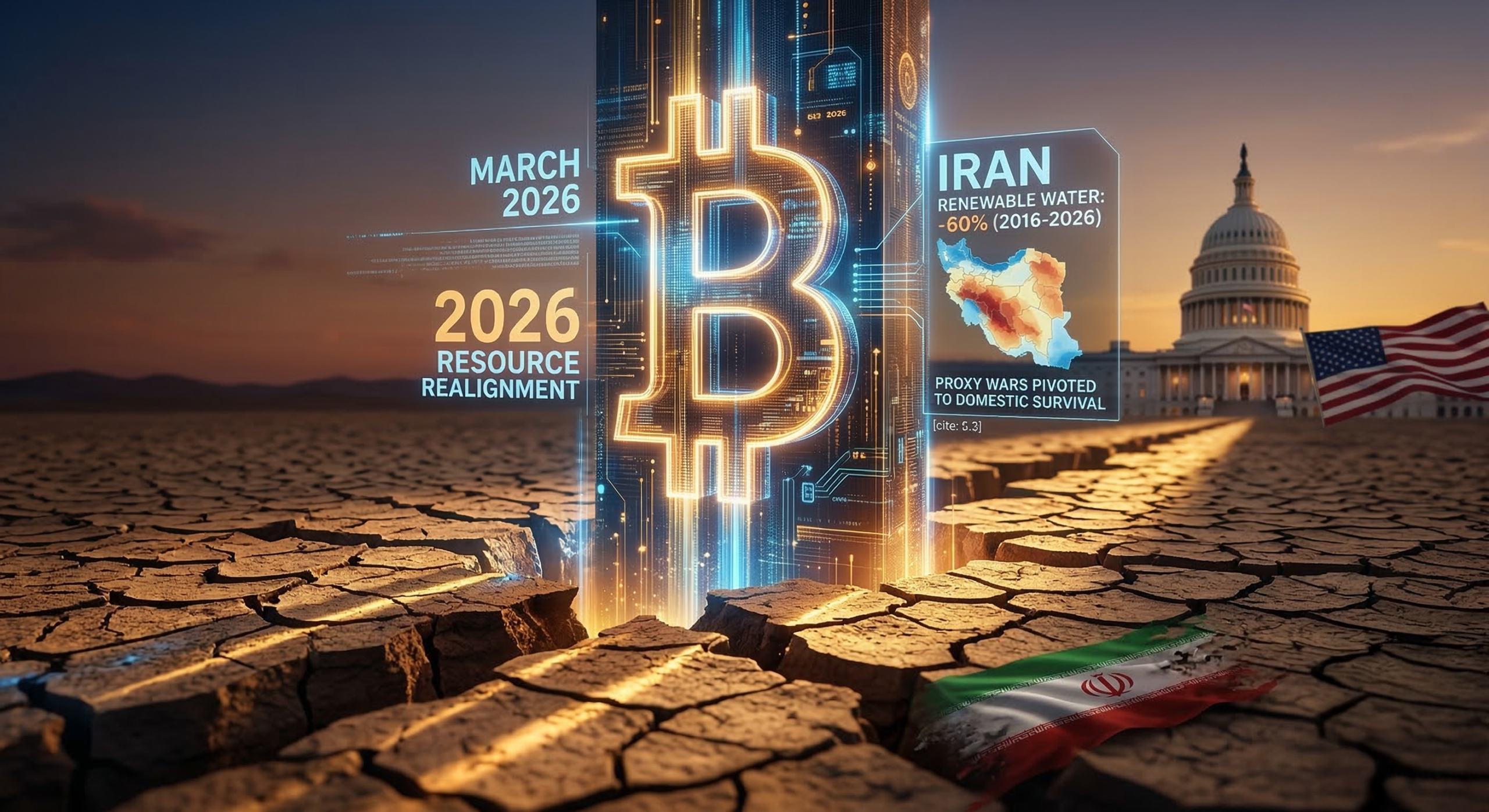
While the world was watching military maneuvers, Iran’s internal stability was being eroded by a historic environmental collapse. In early 2026, reports emerged that Iran’s renewable water resources have plummeted by 60% over the last decade.
- The Resource Shift: Military posturing requires massive capital and internal stability. With major cities facing acute water shortages and agricultural collapse, the Iranian regime has been forced to pivot resources from regional “Proxy Wars” to domestic survival.
- The Result: The “War Premium” on oil is evaporating. As the threat of a kinetic conflict with the U.S. recedes, oil prices have stabilized, allowing Bitcoin to decouple from the energy-shock narrative and return to its primary role as a Digital Store of Value.
2. The “Digital Safe Haven” Decoupling
During the peak of the tension, Bitcoin was being sold off alongside the S&P 500 as “Exit Liquidity”. However, as the “Iran Pivot” became clear this week, we witnessed a structural shift.
- The $70,000 Reclamation: Bitcoin surged +3.37% today, reclaiming the $70k handle. This isn’t just a bounce; it’s a reclamation of support.
- Institutional Confidence: The $1 billion ETF inflow trend we saw earlier in the month is resuming. Investors are realizing that while geopolitical “noise” is temporary, the debasement of fiat currency—driven by the costs of these resource crises—is permanent.
3. The BRICS Strategy: Non-Kinetic Competition
The de-escalation isn’t a sign of weakness, but a shift in strategy. Neutral nations and the BRICS bloc are increasingly moving away from “Kinetic War” (bombs and bullets) toward “Financial Autonomy”.
- The Bitcoin Hedge: By shifting away from military escalation, nations like Iran are looking to fortify their economies through Non-Sovereign Assets. The use of Bitcoin and stablecoins for cross-border settlement in resource-strained regions is hitting record highs.
- The Stablecoin Standard: While oil flows remain stable, the flow of USDT and USDC into Middle Eastern markets has increased by 40% this quarter, as businesses hedge against local fiat instability caused by the environmental crisis.
🦁 Auraski Intelligence Verdict
The “Iran Pivot” proves that in 2026, Resource Scarcity is the new Geopolitics. > The threat to the global economy isn’t a missile; it’s a drought. As Iran focuses inward to manage its water crisis, the “Geopolitical Risk” for crypto has dropped significantly. This has cleared the path for Bitcoin to re-test its $74,000 all-time high without the weight of an imminent world war.
The Bottom Line: We are moving out of a “Fear Cycle” and into an “Infrastructure Cycle.” The de-escalation allows the market to focus back on the CLARITY Act and the Institutional Staking narrative.
The Play: The “War Dip” was the buy. Now, the play is Bitcoin for the macro recovery and XRP as the primary beneficiary of the resumed “Regulatory Clarity” momentum.