











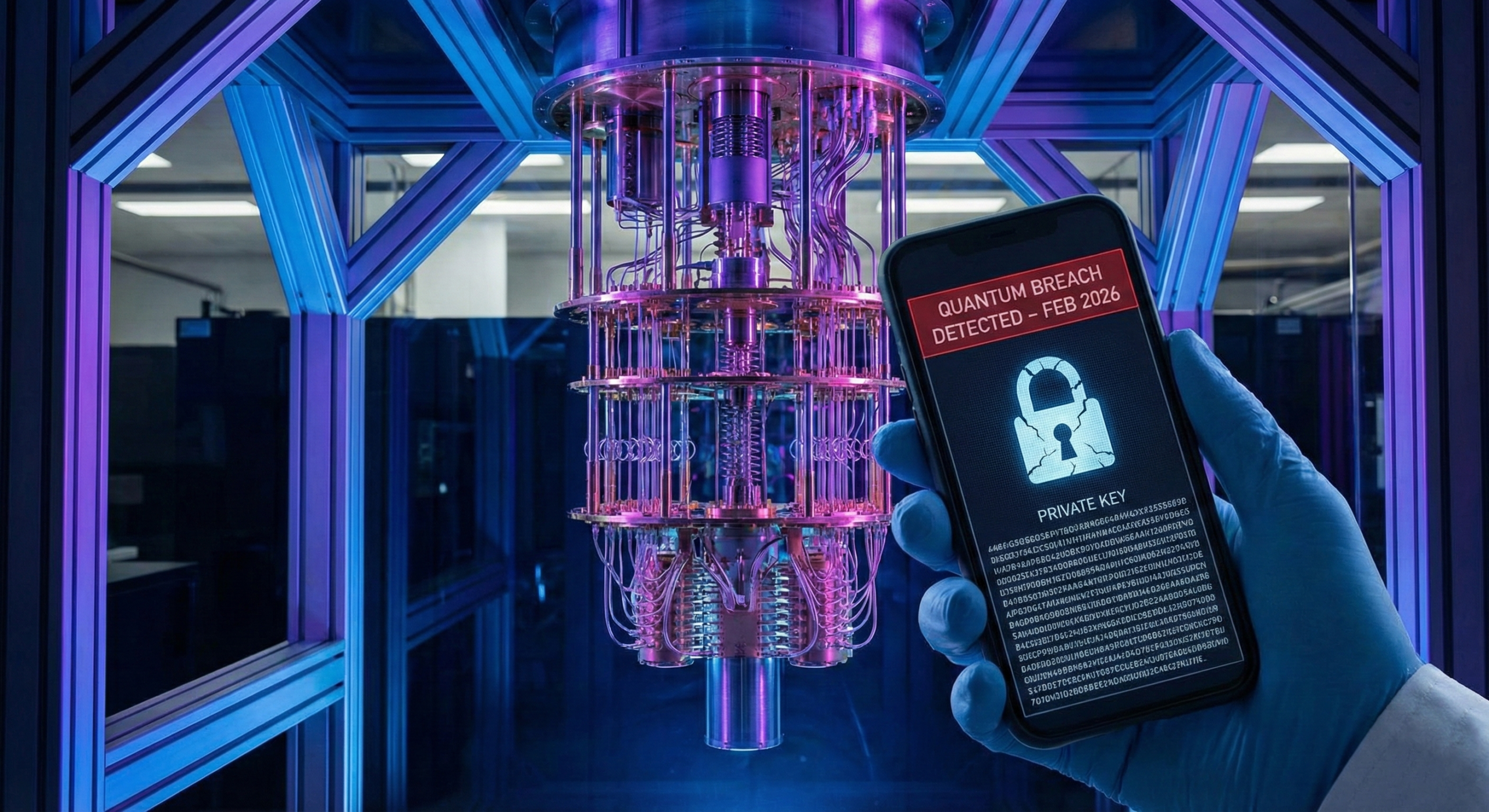
The era of “unbreakable” encryption is officially over. Specifically, as we move through February 2026, the rise of quantum computing is no longer a science-fiction threat. Consequently, the core security of Bitcoin and Ethereum—the Elliptic Curve Digital Signature Algorithm (ECDSA)—is facing its first real existential crisis. At Auraski, we went behind the quantum “noise.” In fact, we found that nearly 4 million Bitcoins are already sitting ducks for a quantum-capable adversary.
Shor’s Algorithm: The Digital Master Key
How can a computer break a code that would take a billion years to crack classically? Specifically, it’s all about Shor’s Algorithm. In fact, while traditional computers struggle with prime factorization, quantum machines use qubits to find the “magical key” in minutes. Furthermore, research in early 2026 indicates that attackers only need about 2,330 logical qubits to bypass Bitcoin’s security entirely. Consequently, if you have ever reused a public address, your private key is effectively public data to those with the right hardware.
The “Harvest Now, Decrypt Later” (HNDL) Strategy
Additionally, the danger isn’t just in the future; it is happening right now. Specifically, intelligence agencies and state-sponsored hackers are performing “HNDL” attacks. In fact, they are capturing massive amounts of encrypted blockchain data today. Consequently, even if they can’t crack it this morning, they are saving it for the moment their quantum processors go online. As we warned in our 2026 Crypto Security Guide, your “Cold Storage” from 2021 might already be in a hacker’s database waiting for the “Q-Day.”
SHA-256 vs. ECDSA: The Weakest Link
Furthermore, it is important to distinguish between mining and spending. Specifically, Bitcoin’s mining algorithm (SHA-256) is relatively quantum-resistant. However, the digital signatures you use to move funds are not. In fact, nearly 25% of all Bitcoin supply sits in “Legacy” or “P2PK” addresses where the public key is already exposed. Consequently, these 4 million coins—including Satoshi’s legendary stash—could be wiped out in a single “Quantum Massacre” before the network can even fork to a new standard.
The Post-Quantum Resistance (PQC) Movement
In fact, the industry is finally fighting back. The NIST (National Institute of Standards and Technology) has finalized the first PQC standards for 2026. Specifically, projects like the Quantum Resistant Ledger ($QRL) and Zcash ($ZEC) are leading the way with hash-based and lattice-based signatures. Furthermore, major chains are now testing “Quantum Overlays.” Check our recent report on Top AI Crypto Projects 2026 to see which AI-driven security protocols are surviving this shift.
⚡ Auraski’s Verdict
Quantum computing is the ultimate “Black Swan” event for the 2026 market. Furthermore, the “Harvest Now, Decrypt Later” threat means the clock is already ticking. In fact, the greatest danger is not the technology itself, but the arrogance of holders who refuse to rotate their addresses. Specifically, if your public key is exposed, you are holding a ticking time bomb.
The vault is cracking. Are you moving your funds or waiting for the breach? Follow Auraski.com for the Q-Day countdown.