



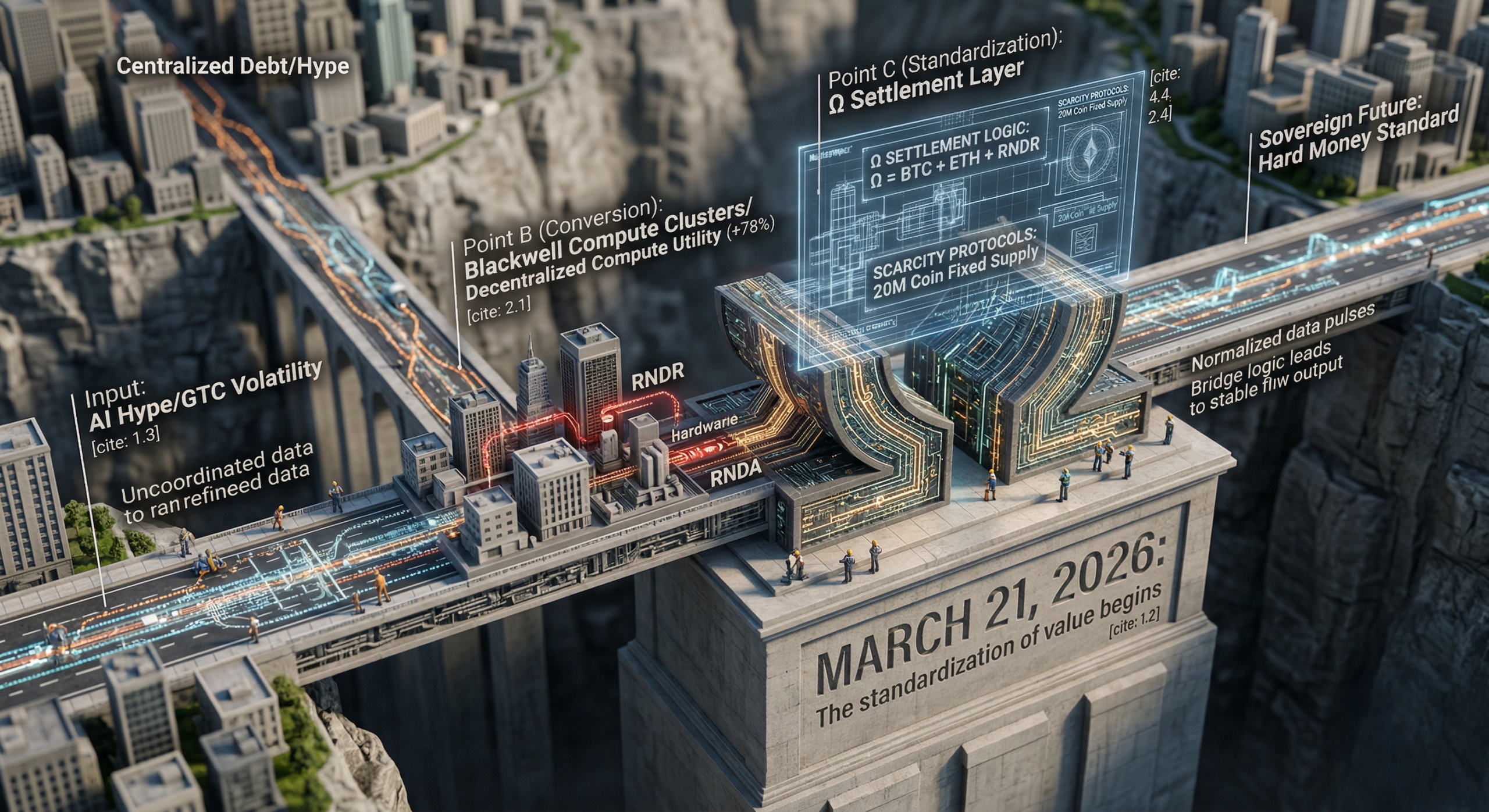







By Auraski Intelligence
Definitive Guide to Core Blockchain Architecture
For the first fifteen years of blockchain history, the industry was locked in a foundational trade-off known as the “Blockchain Trilemma.” Coined by Ethereum’s Vitalik Buterin, this principle stated that a monolithic blockchain—one that handles all core functions—can only maximize two of three properties: Decentralization, Security, or Scalability.
The 2020s were defined by massive congestion, high fees, and fragile, “hype-driven” monolithic protocols. This established a ceiling on institutional adoption. To scale to the magnitude required for the “$100 Trillion Wealth Market” and a standardized token economy, a new architecture was needed.
This guide explores that new standard: The Modular Blockchain Thesis.
Part 1: The Monolithic Wall
Early blockchains, like Bitcoin and pre-Merge Ethereum, were Monolithic. This means every full node on the network was responsible for four distinct “Stack Functions” for every single transaction:
- Execution: Processing and updating the account balances.
- Settlement: The final resolution and conflict resolution layer (where assets are formally secured).
- Consensus: The global network’s agreement on which transaction batch is valid.
- Data Availability (DA): Proving that the transaction data has been formally stored and published to the network.
The Monolithic Wall is simple: As you increase activity (Scalability), you increase the computational requirement for every node. This raises the cost to run a node, which centralizes the network (destroying Decentralization). This inherent trade-off defined the “Safe” index for years.
Part 2: The Modular Pivot
The Modular Blockchain Thesis breaks this paradigm by specializing. Instead of one chain trying to do everything, the architecture separates the stack functions into specialized, integrated layers.
Think of it as the difference between a one-man restaurant (Monolithic) and an industrial-scale kitchen (Modular), where different stations specialize in preparation, cooking, and service.
A. The Execution Layer: Enter the Rollups
This layer specializes only in processing transactions. Rollups (Optimistic or Zero-Knowledge) process the data off-chain (where it’s cheap and fast) and only submit a minimal cryptographic proof or a data summary to the main chain.
- Key Distinction: Rollups increase throughput by thousands of percentage points while still relying on the main chain for security.
B. The Data Availability (DA) Layer: The Infrastructure Bedrock
This specialized layer only has one job: Ensuring that the data for the execution layer has been stored and is accessible. By offloading data storage from the settlement chain, fees for users plummet.
- Key Distinction: Specialized DA protocols utilize mathematical tricks (like erasure coding and data availability sampling) to prove security and availability far more efficiently than monolithic nodes.
C. The Settlement and Consensus Layers: The Foundation
This layer, like Ethereum (after its modular pivot), specializes only in conflict resolution and security. It doesn’t process many user transactions; it settles the final balances from thousands of modular chains.
Part 3: The Upcoming Technology: The ZK-EVM Standard
Within the modular stack, one technology is emerging as the ultimate coordinating layer, especially for highly regulated institutional markets: Zero-Knowledge Ethereum Virtual Machines (ZK-EVMs).
A ZK-EVM allows developers to write standard Ethereum code, but instead of the entire network re-executing that code to verify its validity, the code generates a complex cryptographic proof.
This provides two structural advantages for standardizing Web3:
- Scale with Total Privacy: A ZK-EVM allows institutions to process thousands of transactions in a compliant, private environment, and then submit a simple proof to the main chain that confirms all rules were followed—without revealing the private trade data.
- Unification of Liquidity: By sharing the same proof standard, ZK-EVMs from different providers can theoretically communicate seamlessly, preventing the fragmented, “bridge-heavy” liquidity that defined previous hype cycles.
🦁 Auraski Intelligence Long-Term Verdict
The Modular Thesis is not a narrative; it is the Structural Evolution of Web3.
The Bottom Line: In computer science, specialization always precedes scaling. Monolithic chains were the necessary first draft. The standardized future will be built on Modular Architecture because it is the only design that offers high throughput and decentralized security simultaneously.
The Investment Signal: The true exponential growth over the next decade will not be captured by single monolithic “ETH-Killers.” It will be captured by the Data Availability protocols that secure the data flow, and the specialized ZK-EVMs that generate the standardized proofs that unify global liquidity. The $6 billion in supply rotation we tracked in early 2026 was the institutional capitulation away from obsolete structures and into this new modular standard.