











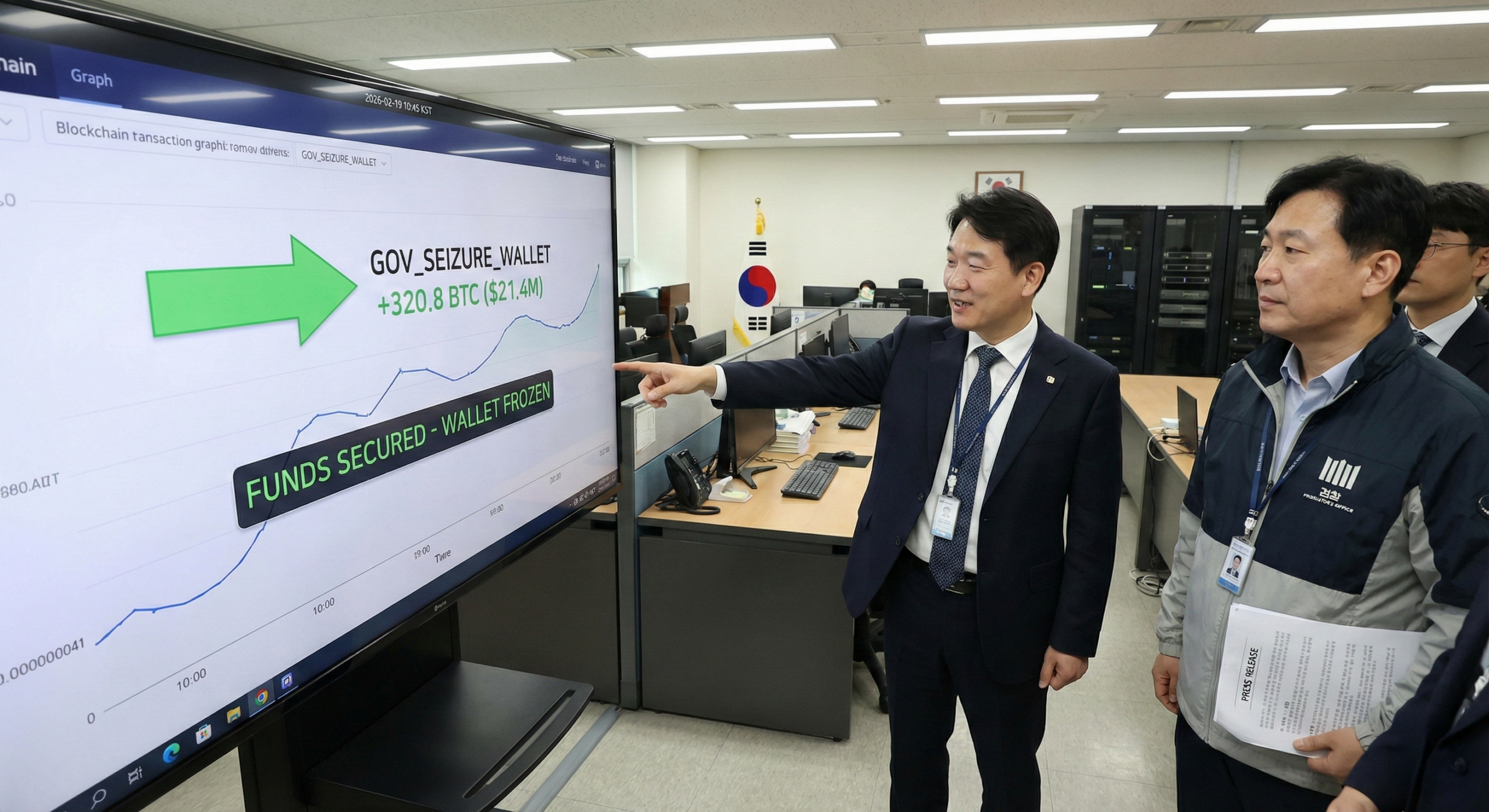
February 19, 2026 — In a rare victory for law enforcement in the digital wild west, South Korean prosecutors have successfully recovered 320.8 Bitcoin (~$21.4 million) that were stolen from their own custody last year. In a bizarre twist, the hackers—finding themselves trapped by a global financial blockade—voluntarily returned the full amount to the authorities’ electronic wallet on Tuesday, February 17.
This event marks one of the most significant recoveries of “stolen from the state” assets in crypto history, highlighting a new era where the “exit” for cybercriminals is becoming increasingly narrow.
1. The Breach: A “Phishing” Disaster in Gwangju
The story began in August 2025, when the Gwangju District Prosecutors’ Office realized its digital vault had been drained. The assets—320.8 BTC originally seized from a family-run illegal gambling operation—were siphoned off during a routine internal handover process.
The investigation revealed a surprisingly “low-tech” entry point for a high-value heist:
- The Victim: An asset manager within the prosecutor’s office.
- The Hook: Investigators mistakenly accessed a phishing website designed to look like a legitimate “cold wallet checker”.
- The Mistake: Believing they were simply verifying the wallet’s balance, the staff entered the recovery seed phrases, handing the keys to the kingdom directly to the hackers.
2. The Blockade: Making Bitcoin “Untouchable”
Unlike traditional bank robberies where the money vanishes into the shadows, these hackers faced the “transparency trap” of the blockchain.
As soon as the theft was confirmed, South Korean authorities collaborated with domestic and international centralized exchanges to blacklist the hacker’s wallet addresses. By “tainting” the coins, prosecutors made it virtually impossible for the hackers to convert the BTC into fiat or move it into a liquid market.
Faced with a $21 million treasure they could not spend or sell, the hackers chose a path of least resistance: unconditional return.
3. The “Ghost” in the Machine
While the funds have been safely moved to a local exchange for secure storage, the culprits remain at large.
- No Identity: Despite the return of the funds, the hackers’ identities remain unknown.
- Nationwide Crisis: The Gwangju case has triggered a massive audit of all seized digital assets in South Korea.
- Other Losses: This audit has already uncovered a separate “disappearance” of 22 BTC from the Seoul Gangnam Police Station, which had been missing from a cold wallet since 2021 without detection.
🦁 Auraski Intelligence Verdict
The “voluntary” return of $21 million isn’t an act of mercy—it’s an act of defeat.
Law enforcement is finally learning that you don’t need to find the hacker if you can kill the liquidity. By working directly with exchanges to block the “off-ramps,” prosecutors turned $21 million in Bitcoin into worthless code for the thieves.
The Lesson: In 2026, the human layer remains the weakest link in security, but the blockchain’s transparency is becoming law enforcement’s greatest weapon.