










While the retail crowd is panicking over Bitcoin’s latest “War Dip” to $68,000, the “Smart Money” is celebrating a far more important victory. This week, two of the most significant pillars of the crypto economy—Kraken and Strike—officially breached the fortress of the legacy banking system.
We are no longer just “renting” access to the financial system. We are building our own.
1. Kraken Financial: The First Crypto Firm Inside the Fed
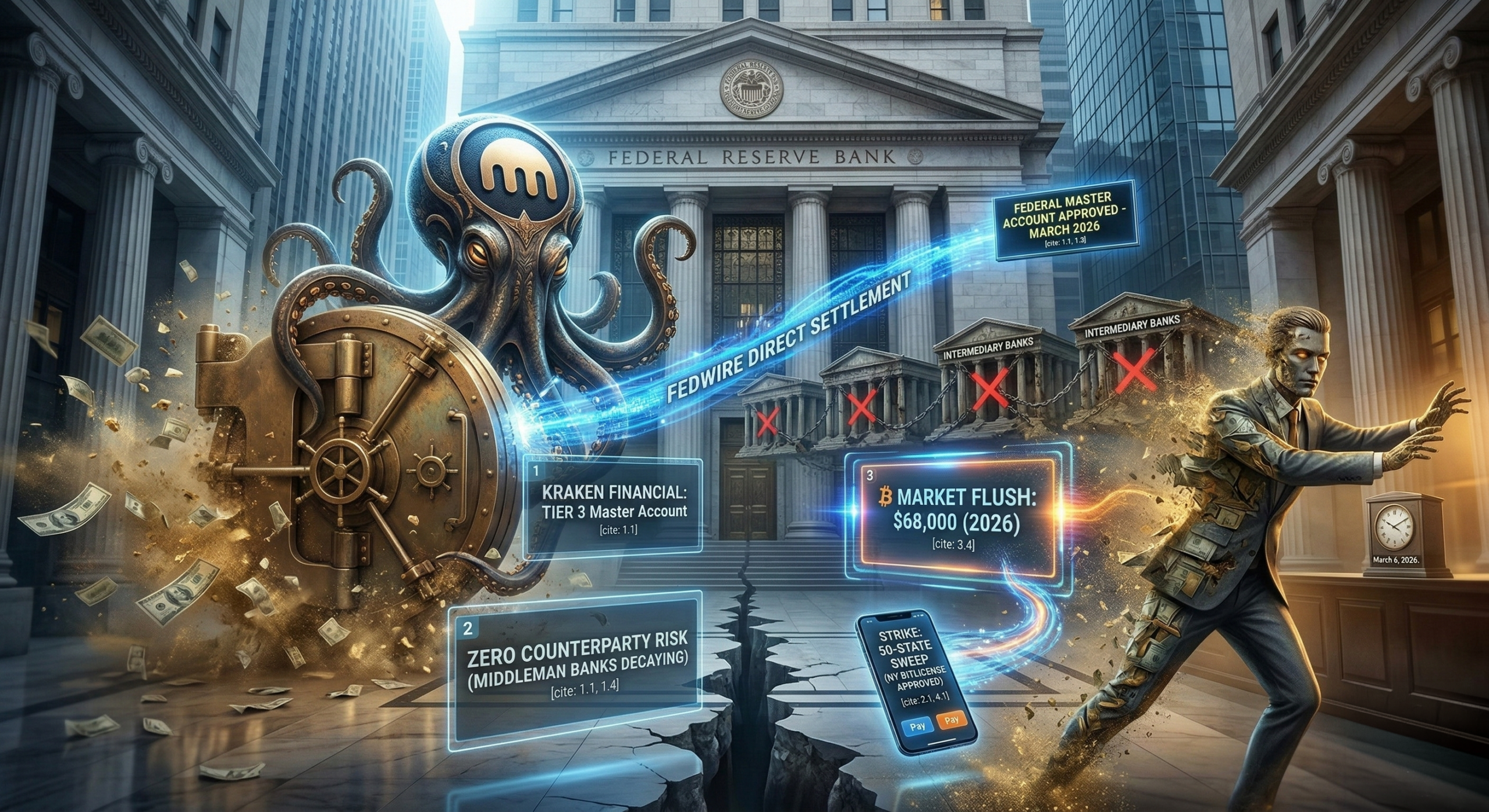
On Wednesday, March 4, 2026, Kraken Financial (a Wyoming-chartered SPDI) achieved what was once considered impossible: it was granted a Federal Reserve Master Account.
- The Breakthrough: Historically, crypto exchanges had to beg traditional banks (like Silvergate or Signature) to move their dollars. With a Master Account, Kraken now has a direct seat at the table with the Federal Reserve.
- The “Skinny” Account: While it’s a “limited purpose” account (Tier 3), it allows Kraken to settle dollar transactions directly on Fedwire without an intermediary bank.
- The Impact: For institutional clients, this means faster settlement, lower fees, and—most importantly—zero “counterparty risk” from middleman banks that might decide to “de-bank” crypto firms.
2. Strike: The 50-State Sweep & The New York BitLicense
As if the Kraken news wasn’t enough, Jack Mallers’ Strike announced today that it has finally secured its New York BitLicense and Money Transmitter License.
- The Final Frontier: New York is the toughest regulatory market in the world. By securing this license, Strike has officially completed its rollout across all 50 U.S. states.
- Bitcoin-Native Services: New Yorkers can now use Strike to buy BTC, automate recurring buys, and—most crucially—pay utility bills, mortgages, and credit card balances directly from their Bitcoin balance.
- The “1:1” Standard: Strike emphasized that all assets are held 1:1 and never lent out, providing a regulated “Sanctuary” for users in the Empire State.
3. Why This Is the “Banking Revolution” of 2026
This isn’t just a win for two companies; it’s a structural shift for the entire asset class.
| Feature | The Old Way (Pre-2026) | The New Way (Post-Kraken/Strike) |
| Settlement | T+2 (Delayed by banks) | Atomic/Fedwire (Real-time) |
| Fees | High (Correspondent bank cuts) | Low (Direct connection) |
| Reliability | “At the mercy of the bank” | Direct Federal access |
| Reach | Fragmented (State-by-state) | Unified (50-state legal coverage) |
🦁 Auraski Intelligence Verdict
Jamie Dimon and the banking elite are currently lobbying to stop the CLARITY Act, but they’ve already lost the infrastructure war. >
Kraken is now effectively a bank for the digital age, and Strike is the mobile interface for a global Bitcoin economy. When you can get a Fed-settled “Direct Deposit” into a Bitcoin account that pays your mortgage, the traditional bank account becomes an obsolete relic of the 20th century.
The Bottom Line: Price volatility is noise; Infrastructure is signal. The pipes of the world’s financial system were just re-wired.
The Play: If you are an institutional player, the move is toward Kraken Financial for settlement. If you are retail, the move is toward Strike for circular economy utility.